


This is Ink & Intrigue—the blog where romance ignites, secrets simmer, and every love story hides a twist. I’m your blog host, Sheila Kell, a romance author and lover of plot twists, slow burns, and morally questionable book boyfriends.
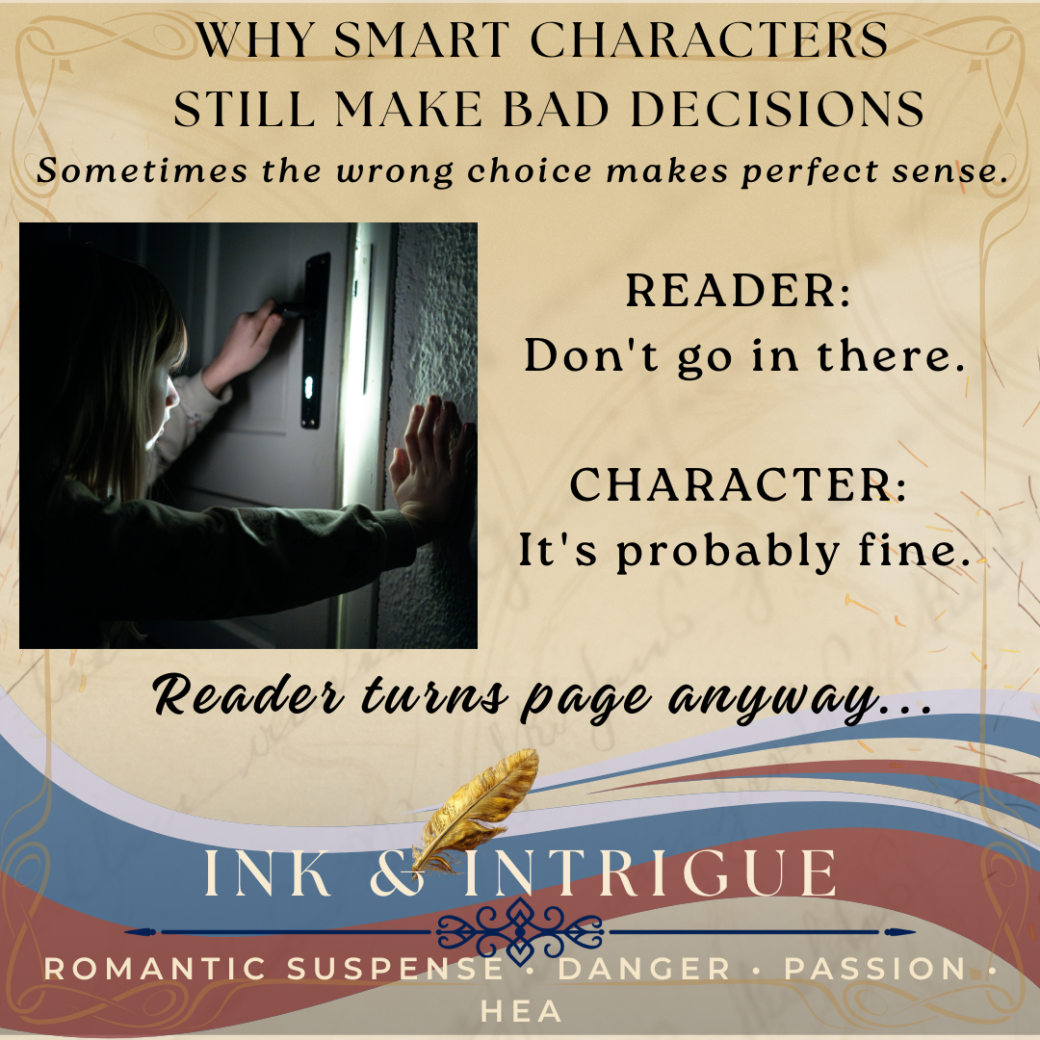
There are few things more entertaining than being a reader who can clearly see that a character is about to make a terrible decision.
You know the moment. The heroine hears a noise downstairs.
- You think, Call someone. She reaches for the nearest object that could theoretically be used as a weapon.
- You think, Excellent. Now call someone. She opens the bedroom door.
- No. She starts down the stairs.
- Absolutely not.
And yet, there you are, turning the page as fast as you can. 😂
As a romantic suspense author, I spend a lot of time putting intelligent, capable people in situations where there isn’t always an obvious right choice. Sometimes they make excellent decisions.
Sometimes they don’t.
But there’s an important difference between a character making a bad decision and an author making a character behave foolishly just because the plot needs something to happen.
One can make a story better. The other can make readers want to throw the book across the room.
Smart People Don’t Always Make Smart Choices
Intelligence doesn’t make anyone immune to fear, anger, grief, guilt, love, or desperation.
We all know what we’re supposed to do in certain situations. That doesn’t mean we’ll actually do it when emotions are involved.
- A character may know she should wait for backup, but someone she loves is in danger.
- A hero may know he’s too injured to continue, but stopping means someone else has to take his place.
- A woman may know she should tell someone about the threatening message she received, but doing so could endanger another person.
Those aren’t necessarily stupid choices. They’re emotional choices. And sometimes those are far more interesting.
Readers Know Things the Characters Don’t
This is especially important in suspense.
As the reader, you may have information the characters don’t.
Maybe you’ve spent a scene with the villain.
- You know the seemingly helpful stranger can’t be trusted.
- You know someone has been watching the house.
- You know there’s something waiting behind that door.
So when the heroine decides to trust someone, you’re screaming: NO! NOT HIM!
But she hasn’t read the previous chapter. Which seems terribly inconsiderate of her.
The decision has to make sense based on what the character knows, not what the reader knows. That gap can create wonderful tension.
Sometimes There Isn’t a Good Choice
These are some of my favorite situations to write.
- Option A is bad.
- Option B is worse.
- And Option C might get everybody killed.
Choose wisely.
- A character might have to decide whether to trust someone who has already lied to her or face the danger alone.
- A hero may have to choose between following orders and going after someone he loves.
- A heroine might have information that could save lives, but revealing it could put a target on someone else’s back.
Now the question isn’t: What’s the smart thing to do?
It’s: Which consequence can this character live with?
That’s much more interesting.
Love Is Terrible for Risk Assessment
Let’s be fair to our romantic suspense characters.
We ask them to behave rationally while someone they love is in danger. That’s just cruel.
Imagine someone telling you: Stay here. You’ll be perfectly safe. I’m going after the armed killer who may have the person you love.
Are you staying? Some of you are already reaching for your shoes. I know you are. 😂
Love changes the calculation. Suddenly, personal safety may not matter as much anymore. That’s one reason romance and suspense work so beautifully together. Romance raises the emotional stakes of suspense.
Before falling in love, a character may be willing to risk their own life.
After falling in love, they have something else to lose.
And sometimes that makes them more cautious. Sometimes it makes them much, much more reckless.
The Bad Decision Should Belong to the Character
This is where I think bad decisions become interesting rather than frustrating.
The mistake should come from who the character is.
- A fiercely independent heroine may refuse help long after she should accept it.
- A protector may believe he has to handle everything himself.
- Someone who has been betrayed before may refuse to trust the one person telling the truth.
- A character carrying enormous guilt may take a risk because, deep down, they don’t believe their own safety matters as much as everyone else’s.
Those choices may be wrong. But they’re their own wrong choices.
If I’ve done my job properly, the reader might be yelling at the character while also understanding exactly why they’re doing it.
That’s the sweet spot.
Bad Decisions Need Consequences
Here’s where I become considerably less forgiving.
If a character ignores every warning, walks straight into danger, and everything works out perfectly anyway, what was the point?
Choices should matter.
- Maybe someone gets hurt.
- Maybe trust is broken.
- Maybe the villain gains an advantage.
- Maybe the character discovers that being brave and being reckless aren’t the same thing.
Consequences don’t necessarily have to be catastrophic. But the story should acknowledge that the decision had a cost.
Otherwise, it wasn’t really a risk.
And Sometimes the Bad Decision Saves Everyone
Then there’s the wonderfully inconvenient possibility that the character’s terrible decision turns out to be exactly what needed to happen.
She wasn’t supposed to leave the safe house. She did.
Now she’s in danger. But because she left, she sees something nobody else would have seen.
- She discovers the clue.
- Finds the missing person.
- Recognizes the villain.
- Changes the outcome.
Was leaving still a bad decision? Maybe. Was it the wrong decision?
That’s a different question. And that’s where things get interesting.
Characters Don’t Need to Be Perfect
I don’t want my heroes and heroines to make the correct decision every time.
Perfect characters aren’t particularly interesting.
- I want them to misjudge people.
- I want fear to get the better of them occasionally.
- I want them to be stubborn when they should bend and vulnerable when they desperately want to be strong.
- I want love to complicate decisions that once seemed simple.
Most of all, I want their choices to feel true. Because a character doesn’t always have to make the smartest decision.
They have to make the decision that makes sense for who they are, what they know, what they fear, and whom they love.
Even when I’m sitting behind the keyboard thinking… You are really going to regret this. And then writing the next scene anyway. 😏
So tell me, readers: What frustrates you more, a character making a believable bad decision, or a character suddenly doing something completely out of character just to move the plot forward?
Thanks for joining me on Ink & Intrigue, where romance and suspense go hand in hand.
If you enjoyed today’s post, don’t forget to subscribe to stay updated.
Want more behind-the-scenes content, writing tips, or a peek into my books? Visit sheilakell.com or follow me on social media at @sheilakellbooks.
Until next time—keep writing, keep swooning, and remember: every heart has a secret. 💕