


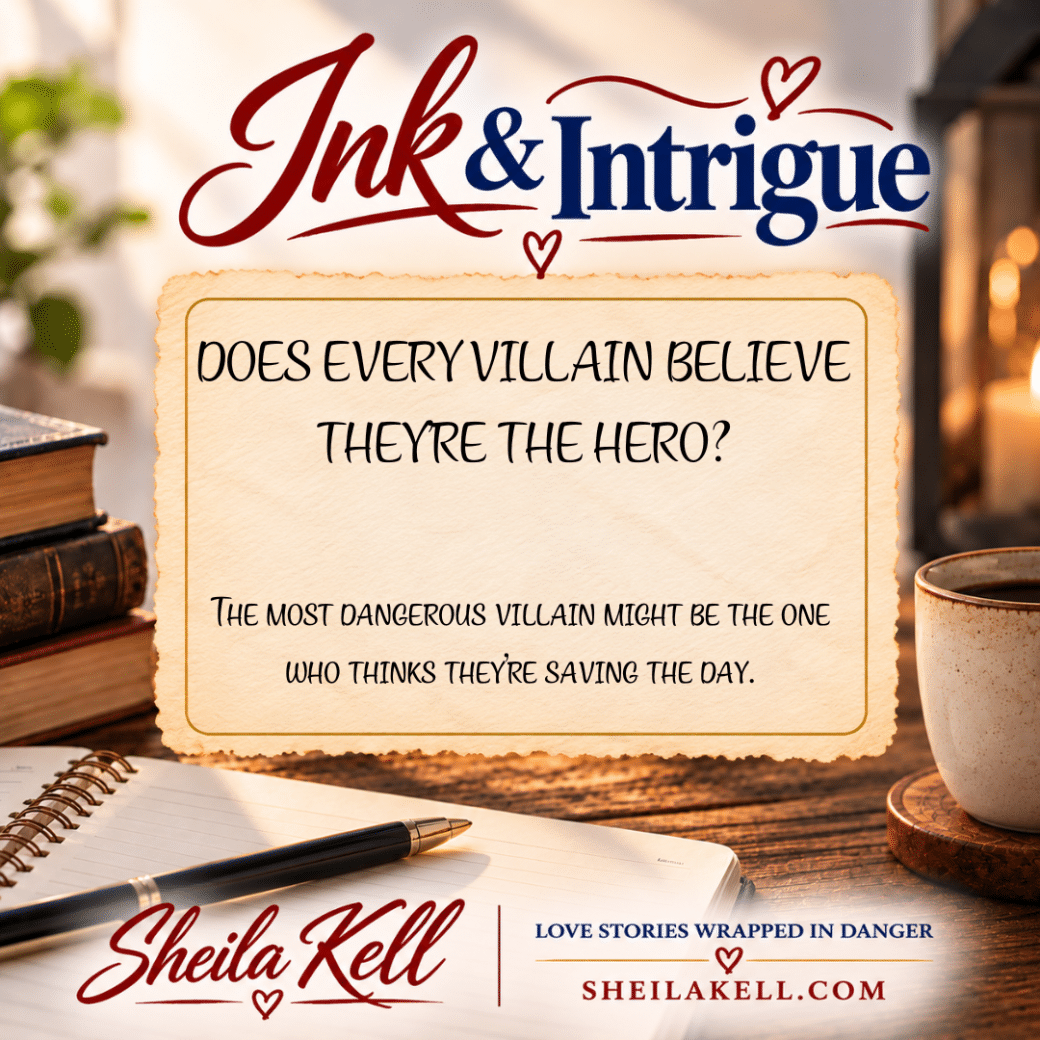
This is Ink & Intrigue—the blog where romance ignites, secrets simmer, and every love story hides a twist. I’m your blog host, Sheila Kell, romance author and lover of plot twists, slow burns, and morally questionable book boyfriends.
There’s something particularly unsettling about a villain who believes they’re doing the right thing. Not the villain who laughs while explaining their elaborate plan to take over the world. Or the one who practically wears a sign that says, “I’m the bad guy.”
I’m talking about the person who looks at the terrible things they’ve done and genuinely believes they were necessary. The one who says, I didn’t have a choice. Or worse… They deserved it.
As a romantic suspense author, I spend a lot of time thinking about what makes someone dangerous. And while a villain with a weapon can certainly create tension, sometimes the most frightening thing about an antagonist isn’t what they’re willing to do.
It’s what they’ve convinced themselves they’re entitled to do.
Everyone Has a Reason
One of the first things I consider when developing a villain is motivation. Why are they doing this? Revenge? Greed? Jealousy? Fear? A desperate need for control?
Those are familiar motivations, but the interesting part is how the villain explains their actions to themselves.
- A person seeking revenge may believe they’re delivering justice.
- Someone obsessed with control may insist they’re protecting their family.
- A jealous antagonist may convince themselves they’re fighting for a relationship that rightfully belongs to them.
- And someone who has been hurt might decide that hurting others is the only way to make things fair.
None of those beliefs excuse what they do. But understanding how a villain justifies their behavior can make them far more believable. After all, most people don’t wake up in the morning, stretch, pour a cup of coffee, and think, What a lovely day to become completely evil.
Although I suppose some of my villains might. 😂
The Story They Tell Themselves
We all have a way of explaining our choices. When we make mistakes, we remember the circumstances. The pressure. The reasons we thought something was a good idea at the time.
Villains can do the same thing, except they may take that reasoning to a dangerous extreme.
- They rewrite events until they’re the injured party.
- They minimize the harm they’ve caused.
- They blame everyone else for forcing their hand.
- And eventually, they may believe their own version of the story so completely that no amount of evidence can change their minds.
Imagine a villain who lost someone they loved because of another person’s mistake. The grief is real. The anger is understandable. But somewhere along the way, they decide that anyone connected to that tragedy deserves to suffer.
In their mind, they’re not committing crimes. They’re balancing the scales. And that’s what makes them dangerous.
Because how do you reason with someone who believes they’re the only person willing to do what’s right?
A Sympathetic Past Doesn’t Make a Villain Innocent
I enjoy writing complicated characters, including antagonists.
But there’s an important distinction between understanding someone’s pain and excusing their actions.
- A villain may have experienced a terrible loss.
- They may have been betrayed.
- They may have spent years feeling powerless or overlooked.
Those experiences can help explain why they became the person they are. But they don’t erase responsibility for what they choose to do next. And I think readers understand that distinction.
We can feel sympathy for someone’s suffering while still wanting them stopped. In fact, that combination can make a story more emotionally powerful. Because sometimes the villain’s original pain is something we recognize.
It’s the choices they make afterward that turn them into someone we fear.
The Most Dangerous Villain May Seem Perfectly Reasonable
Not every antagonist needs to be obviously threatening.
- Some are charming.
- Helpful.
- Respected in their communities.
- The kind of person who remembers birthdays, volunteers at local events, and always seems to know exactly what to say.
Which, naturally, makes them a wonderful person to invite into a suspense novel. Nothing could possibly go wrong. 😏
But seriously, a villain who appears reasonable can be especially effective because other characters may have no reason to suspect them. They don’t behave like the villain everyone expects. They might even do genuinely kind things.
And that creates an uncomfortable question. Can someone who is capable of kindness also be capable of terrible cruelty? Unfortunately, yes.
People are complicated. Fictional people are no exception.
When Love Becomes an Excuse
Romantic suspense gives us another particularly troubling kind of villain.
The one who claims everything they’re doing is for love. They insist they’re protecting someone. They believe they know what’s best. They refuse to accept rejection because they’re convinced the other person simply doesn’t understand how much they love them.
But love isn’t ownership. And protection isn’t control.
A villain who uses love to justify threats, manipulation, or violence isn’t demonstrating devotion. They’re revealing how little they respect the other person’s choices.
That distinction matters to me when writing romance.
A hero may be fiercely protective. He may worry, argue, or struggle to step aside when someone he loves is in danger. But ultimately, love should allow both people to have a voice.
The villain who believes love gives them the right to control someone has crossed a very different line. And sometimes they don’t even recognize that they’ve crossed it.
Does the Villain Know They’re Wrong?
Here’s where things get interesting.
Not every villain believes they’re the hero. Some know perfectly well that what they’re doing is wrong. They simply don’t care. They want money, power, revenge, or something else badly enough to hurt people to get it.
Others may know their actions are wrong but believe the circumstances make them acceptable. And then there are the villains who truly see themselves as the good guys.
- They believe everyone else has misunderstood them.
- That their victims brought the consequences upon themselves.
- That once their plan succeeds, people will finally understand why it had to happen.
Those are three very different mindsets. And each creates a different kind of threat.
- The villain who knows they’re wrong might be persuaded to stop if the cost becomes too high.
- The one who believes they’re justified may see every obstacle as further proof that they’re right.
That’s a difficult person to stop. Especially when they believe they’re on a mission.
The Hero and Villain May Have More in Common Than We Think
One of my favorite ways to explore an antagonist is to consider what they share with the hero or heroine.
- Maybe both have lost someone.
- Both have been betrayed.
- Both want justice.
- Both are fiercely loyal to the people they love.
But when faced with similar pain, they choose differently.
- One seeks justice through lawful means. The other decides the rules no longer apply.
- One learns to trust again. The other turns betrayal into a reason to hurt everyone who gets close.
- One protects the people they love. The other tries to control them.
The difference isn’t necessarily what happened to them. It’s what they decide to do about it.
And sometimes the hero recognizes that difference all too clearly. They understand the villain’s anger because they’ve felt it themselves. They simply refused to let it become something destructive.
That can make their confrontation much more powerful than a straightforward battle between good and evil.
Sometimes the Villain Is the Last Person to See the Truth
There’s a moment I find particularly satisfying in suspense. The villain’s plan begins to unravel. The evidence is undeniable. Their excuses no longer work.
For the first time, they’re forced to confront what they’ve actually done.
- Some villains break.
- Some finally recognize the harm they’ve caused.
- Others double down, insisting that everyone else is wrong.
- And some never accept responsibility at all.
I don’t believe every villain needs a moment of redemption. Sometimes the most realistic ending is that they’re stopped, held accountable, and remain convinced they were right.
Because understanding the truth and accepting it are two very different things.
So, Does Every Villain Believe They’re the Hero?
No.
- Some villains know exactly who they are.
- Some don’t care whether they’re right or wrong.
- And some have built such a convincing story around their own actions that they can no longer recognize themselves as the villain.
Those are often the antagonists who stay with me. Not because their actions are justified. But because their reasoning reveals how easily grief, anger, jealousy, or fear can become something dangerous when someone refuses to question their own beliefs.
A compelling villain doesn’t always need to be larger than life. Sometimes they only need to be someone who has convinced themselves that what they’re about to do is necessary.
And when that person believes they’re the hero? Well, good luck convincing them otherwise.
That’s usually when my heroes and heroines have a very long day ahead of them. 😂
Readers, which villain scares you more: the one who knows they’re doing evil, or the one who genuinely believes they’re the good guy?
Thanks for joining me on Ink & Intrigue, where romance and suspense go hand in hand.
If you enjoyed today’s post, don’t forget to subscribe to stay updated.
Want more behind-the-scenes content, writing tips, or a peek into my books? Visit sheilakell.com or follow me on social media at @sheilakellbooks.
Until next time—keep writing, keep swooning, and remember: every heart has a secret. 💕